
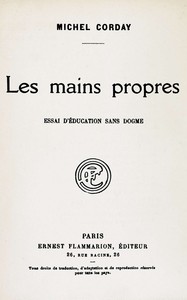
Les mains propres : Essai d'éducation sans dogme by Michel Corday
Picture this: Paris in the early 1900s. A well-off, intellectual couple, Monsieur and Madame Dartès, are fed up. They see the world around them as a mess of outdated traditions, stifling religions, and pointless social rules that caused the recent Great War. They believe all this dogma is what corrupts people. So, when their son Jean is born, they make a radical decision. They will raise him with 'clean hands'—their own hands free of imposing any belief system on him.
The Story
The book follows Jean's life from infancy to his early twenties. His parents' plan is extreme. They don't teach him right or wrong. They avoid any mention of God or religion. They give him facts about science and history but withhold the moral frameworks usually attached to them. They want him to be a blank slate, reasoning his way to truth all by himself. We watch Jean grow, a curious but often confused boy. He observes the world, asks blunt questions his parents refuse to answer, and tries to build his own understanding of love, death, justice, and purpose from scratch. The tension builds not with dramatic events, but with every small choice Jean makes. As he becomes a young man and enters the wider world with its temptations and conflicts, the real test of his parents' experiment begins. The story becomes a quiet, psychological suspense: will the product of this pure freedom be a new kind of human, or just a lost one?
Why You Should Read It
This book hooked me because it’s like a thought experiment you can’t look away from. Corday doesn't preach; he just shows you the setup and lets you watch it play out. You'll find yourself constantly arguing with Jean's parents, then second-guessing yourself. Is sheltering a child from all tradition a form of oppression itself? Jean is a fascinating character—sometimes frustrating, sometimes brilliant, always a product of this bizarre setup. The book’s power is in how it makes you examine your own beliefs. You realize how much of what you consider 'common sense' or 'morality' was actually taught to you. It’s unsettling and incredibly stimulating. For a book written nearly 100 years ago, its questions about education, autonomy, and the search for meaning feel completely modern.
Final Verdict
This is a perfect book for anyone who loves philosophical fiction that doesn't feel like homework. Think of it as a French cousin to novels like 'Brave New World'—a 'what if' story about society. It’s great for book clubs because it will spark fierce debate. You don't need to be a parent to get absorbed in it; you just need to be someone who has ever wondered, 'Why do I think the way I do?' Be prepared for an ending that’s more thought-provoking than neatly wrapped-up. It’s a hidden gem that deserves a fresh look from today's readers.
This is a copyright-free edition. Use this text in your own projects freely.
Elizabeth Moore
1 year agoGreat digital experience compared to other versions.



Melissa Jackson
3 months agoEssential reading for students of this field.