1

Will Somers, the Boy Detective — A Closer Reading
6
3
Project Gutenberg
2019
Detective and mystery stories; Philadelphia (Pa.) -- Fiction; Merchants -- Fiction; Theft -- Fiction; Dime novels; Forgery -- Fiction
Readers of public-domain and historical texts
Project Gutenberg digital edition
en
Edition facts
Words: 42,857
Reading time: 187 min
Text sections: 31
Source:
Project Gutenberg record #60978
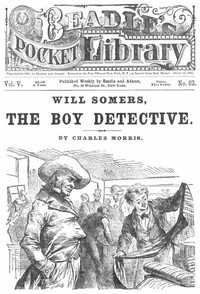
Charles Morris's dime novel follows sixteen-year-old Will Somers, a street-smart boy who talks his way into a Philadelphia dry-goods store and uses slang-laced detective work to solve a series of thefts. The narrative relies on colloquial dialogue, physical description, and incremental clues rather than formal deduction.
Editorial Edition Score
4.8/5
★★★★★
★★★★★
Calculated from edition completeness, EPUB availability, text structure and catalogue metadata. Not a user rating.
Edition quality
The first chapter of Charles Morris's Will Somers, the Boy Detective opens with a sixteen-year-old applicant who announces himself with a drawl: “Got any opening in these diggin’s for a feller of my size and good looks?” The line establishes a voice that is both cheeky and self-aware, and the merchant's curt reply sets up a pattern of verbal sparring. Morris devotes unusual attention to the boy's physique—the “sinewy development of his limbs” visible through rents in his clothes—and to his “classical outline” features, including “straggling curls of dark hair” and “olive-hued cheeks.” This physical specificity, combined with the boy's unapologetic slang, marks him as a protagonist who is observed from the outside before he is allowed to act.
Dialect as a Character Marker
Will Somers's speech is the most consistent authorial choice in the excerpts. He uses contractions and colloquialisms that set him apart from the merchants and officers: “I ain't partik'lar,” “I axed him,” “Bet I bring them up with a half-hitch.” The dialogue is not merely decorative; it signals his social position and his self-constructed identity as a shrewd outsider. When Miss Arlington asks about his suspicions, Will replies, “Never mind now… There's more than one in it. Been spotting them for some time.” The clipped, confident phrasing suggests a boy who has learned to guard his information. Morris also contrasts Will's vernacular with the more formal speech of Mr. Leonard and the officer, creating a linguistic divide that reinforces the tension between the boy's low status and his growing influence.
The Store as a Stage for Suspicion
The dry-goods store is not just a setting but a mechanism for generating suspicion. Morris uses the physical layout—the basement, the cellar, the counter—as spaces where thefts can occur unseen. The investigation proceeds through incremental details: a piece of cloth given to a ward, a suspicious old man visiting Will, and the discovery that robberies have been occurring “over a year.” The officer, Mr. Fitler, insists that “the work could not have been done without an accomplice here,” narrowing the field of suspects to the employees. Morris's descriptions of the store are functional rather than atmospheric; the building exists to be watched, searched, and doubted. The reader is invited to track clues alongside the characters, but the excerpts leave many connections implied rather than stated.
Physical Description and the Body as Evidence
Morris repeatedly describes Will's body in ways that suggest both vulnerability and capability. The “rent in his well-worn clothes” hints at poverty, while the “sinewy development” implies physical readiness. When Will stands “in an erect, easy attitude” under the merchant's sharp look, his posture becomes a form of defiance. Later, the officer suggests following the boy to learn “his places of resort and associates,” treating his movements as potential evidence. This attention to the protagonist's physicality is unusual in dime-novel detective fiction, which often prioritizes action over description. Morris uses the body as a text to be read: Will's appearance invites trust or suspicion, and his own awareness of this—his “confident manner” and “assured air”—becomes a tool in his investigations.
The Limits of the Excerpts: Unresolved Threads
The provided excerpts cover only the opening chapters and a later conference scene, leaving the full trajectory of the plot unclear. Will's claim that he will “take him out of jail” refers to John Elkton, but the nature of Elkton's involvement—whether he is a thief, a dupe, or a red herring—is not revealed. Similarly, the officer's plan to “spot” the old man who visited Will is mentioned but not followed through. Morris introduces multiple suspects (Will himself, the “counter-jumper,” the mysterious visitor) without resolving their roles in the excerpts. Readers should expect a story that builds through incremental revelations and relies on Will's inside knowledge, but the complete resolution of the thefts and the clearing of Elkton's name are only hinted at in the material available.
Morris's prose is lean and functional, favoring dialogue and action over interior reflection. Readers who enjoy period slang and the mechanics of a store-based mystery will find the text engaging, but those seeking psychological depth or elaborate plotting may need to adjust expectations. The dime-novel format rewards quick reading and incremental clue-dropping, and Will Somers's confidence—expressed in phrases like “I never said a thing I didn't do”—carries the narrative forward even when the evidence is thin.
Reader reflection
Take a moment to reflect on this book
Create a short personal record of your experience with this book.
Your progress
0
/
10
2
How much did you enjoy the reading experience?
3
Is this a title you would suggest to others?
4
How much effort did this book require?
5
How strong was your personal connection to the text?
6
Did any part of the book stay with you emotionally?
7
How well did it match your expectations?
8
Which part made the strongest impression?
9
Which lesson or insight stayed with you?
10