
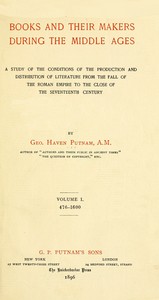
Books and their makers during the Middle Ages : A study of the conditions of…
Let's be honest, the title sounds like a dry academic paper. But trust me, it's a hidden gem. George Haven Putnam's book is a detective story about the book itself. It asks a simple question we rarely think about: how did a book get from an author's mind into your hands 700 years ago?
The Story
The plot isn't about a single person, but about an object—the handwritten book—and its journey through society. It starts in the monasteries, where monks spent years copying texts. This was knowledge under lock and key. Then, we see the rise of universities and a new hunger for books. Suddenly, there's a market. Professional scribes and illustrators set up shop in cities. The book follows these early "makers," the people who sourced the parchment (often from sheepskins!), mixed the inks, did the painstaking writing, and bound the pages. It shows the whole messy, human supply chain. It also looks at the rules—guilds that controlled who could make books, and how authors (if they were lucky) got paid. The story ends as the world stands on the brink of the printing press, showing us why that invention was such a massive explosion.
Why You Should Read It
I loved this because it makes you appreciate every book on your shelf. Reading about a scribe accidentally spilling ink on a page he'd worked on for months is painfully relatable. Putnam pulls you into their world. You feel the cramp in their hands and understand why a single Bible could cost as much as a house. It's not just about facts; it's about the people behind the facts. The monk preserving ancient texts, the merchant financing a beautiful illustrated manuscript, the student desperately trying to borrow a textbook to copy. It reframes the Middle Ages not as a "Dark Age," but as a time when people were fiercely, creatively fighting to keep and spread light, one costly, beautiful page at a time.
Final Verdict
This is a perfect read for curious minds who love history but want to see it from the ground up. If you're a fan of books like The Swerve or just love learning how everyday things came to be, you'll enjoy this. It's also great for writers and artists—a powerful reminder of the physical labor that ideas once required. It's a bit old-fashioned in style (it was written in the 1890s), but that adds to its charm. You're getting a history of medieval books from a guy who was himself a major publisher in the 19th century. How cool is that? Give it a chance—it will change how you see the simple act of opening a book.
This title is part of the public domain archive. Enjoy reading and sharing without restrictions.
Sarah Brown
1 year agoSurprisingly enough, the storytelling feels authentic and emotionally grounded. Absolutely essential reading.
Susan Hernandez
1 year agoSimply put, the storytelling feels authentic and emotionally grounded. A true masterpiece.
Daniel Flores
4 months agoI came across this while browsing and the storytelling feels authentic and emotionally grounded. Exactly what I needed.
William Harris
1 year agoIf you enjoy this genre, the clarity of the writing makes this accessible. Don't hesitate to start reading.


Paul Wright
1 year agoFast paced, good book.