
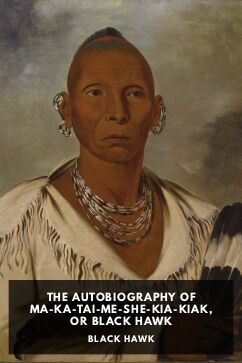
The Autobiography of Ma-Ka-Tai-Me-She-Kia-Kiak, or Black Hawk - Black Hawk
I picked up this book thinking I'd get a straightforward war story. What I found was something much more personal and immediate.
The Story
Black Hawk, a respected leader of the Sauk people, tells his life story. He describes his childhood along the lush banks of the Mississippi, his first experiences in battle, and his deep connection to his village and its burial grounds. The core of the narrative focuses on the years leading up to 1832. After a disputed treaty forces his people across the river, Black Hawk and about 1,000 followers—including women and children—cross back into Illinois. They aren't looking for war; they're trying to plant corn and reclaim their home. What follows is a tragic series of misunderstandings, panic from settlers, and a brutal military response. The book details the hunger, the desperate retreat, and the final massacre at Bad Axe River. It ends with Black Hawk as a prisoner, forced to tour Eastern cities, seeing the sheer scale of the nation that had overwhelmed him.
Why You Should Read It
This book flips the script. American history often paints figures like Black Hawk as obstacles to progress. Here, you get his reasoning. You feel his outrage at seeing his ancestors' graves plowed under. You understand his confusion when agreements are broken. It's not a glamorous tale of battle; it's a sobering account of collapse and resilience. His voice, filtered through an interpreter but still potent, is proud, sad, and defiant. There's a moment where he describes seeing the endless streets and buildings of the East, and the sheer hopelessness of that realization is breathtaking. It adds a human face to a history we often only know in broad strokes.
Final Verdict
This is a must-read for anyone who loves firsthand historical accounts or wants to understand the roots of American expansion from a different angle. It's not a long or difficult read, but it's a heavy one. Perfect for history buffs who are tired of the textbook version, for readers of memoirs, and for anyone who believes that the most important stories are the ones told by the people who lived them. Just be prepared—it might change how you see a piece of the American story.
Legal analysis indicates this work is in the public domain. Use this text in your own projects freely.
Liam Jackson
7 months agoI came across this while browsing and the emotional weight of the story is balanced perfectly. Exactly what I needed.
Paul Perez
11 months agoRecommended.
George Martin
7 months agoBeautifully written.
Anthony Clark
1 year agoWithout a doubt, it challenges the reader's perspective in an intellectual way. Don't hesitate to start reading.

Kimberly Martinez
8 months agoRight from the opening paragraph, the evidence-based approach makes it a very credible source of information. It’s a comprehensive resource that doesn't feel bloated.