1

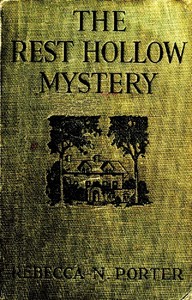
The Rest Hollow Mystery — Themes and Context
25
11
Project Gutenberg
2012
Murder -- Fiction; California -- Fiction; Mystery fiction; Amnesiacs -- Fiction
Readers of public-domain and historical texts
Project Gutenberg digital edition
en
Edition facts
Words: 63,806
Reading time: 278 min
Text sections: 6
Source:
Project Gutenberg record #40416
Kenwick wakes in a California canyon with amnesia, a crushed hat, and a blood-spattered clue. As he pieces together his past, a ruby pendant, a hypnotist's gaze, and a confession to a photographer expose tensions between memory and identity, trust and manipulation.
Editorial Edition Score
4.7/5
★★★★★
★★★★★
Calculated from edition completeness, EPUB availability, text structure and catalogue metadata. Not a user rating.
Edition quality
The novel opens with Kenwick regaining consciousness in a bleak November canyon, his clothes full of burrs and his hat crushed. He has no memory of the accident that left him with a throbbing leg and a blood-spattered triangle of glass. The landscape—sage-covered slopes, twisted manzanita, moaning sycamores—mirrors his disorientation. Porter establishes a pattern of physical and mental fragmentation: Kenwick's memory struggles to "clear a passage back to the present," while his body drags itself through tangled underbrush. The setting is not merely atmospheric; it is a character in his confusion.
Amnesia as a Structural Device
Kenwick's amnesia is not a simple plot hook but a persistent condition that shapes his interactions. He describes it as an "illness" that "paralyzes his initiative" and gives him "the patience of despair." This is not a convenient forgetfulness that clears up when needed; it is a debilitating state that forces him to reconstruct his identity from external clues—his clothes, his surroundings, the reactions of others. When he confesses to the photographer Jarvis, he admits he cannot afford to lose his last friend, revealing how amnesia erodes trust in oneself and others. Porter uses this condition to explore how memory, or its lack, governs agency and relationships.
The Language of Hypnosis and Will
A recurring motif is the language of hypnosis and willing submission. In one scene, a female character toys with a ruby pendant while telling her escort he could "make a wonderful hypnotist." She notes that hypnotism requires cooperation—"unless the victim were willing"—and then softly adds, "perhaps the victim is willing." This exchange, set over sugar bowls and oval platters, layers domesticity with menace. The escort's reply—"You need me and I need you"—frames their relationship as a transactional pact. Porter uses this dialogue to suggest that characters are not merely suspects but participants in a dance of control and consent, where memory gaps may be exploited or self-imposed.
Concrete Clues and the Weight of Objects
Porter grounds the mystery in tangible, often gruesome details. The blood-spattered triangle of glass, the crushed hat, the torn madrone tree with roots like "grotesque claws"—these objects carry the weight of evidence and emotion. Kenwick's examination of the wreckage is methodical: he searches for half an hour, dreading to find a body. Later, the ruby pendant is described as "obviously a genuine and costly stone," and the woman puts "a cruel strain upon its slender thread-like chain." These objects are not mere props; they are charged with symbolic and practical significance. The glass and the pendant become focal points for suspicion and desire, anchoring the narrative's abstract tensions in physical reality.
Readers attentive to Porter's use of setting, dialogue, and object detail will find that the mystery unfolds not through sudden revelations but through accumulated, often contradictory, impressions. Kenwick's amnesia is not a puzzle to be solved but a lens through which every character's reliability is questioned. Pay close attention to what characters say about cooperation and will—these exchanges may be more revealing than any confession.
Reader reflection
Take a moment to reflect on this book
Create a short personal record of your experience with this book.
Your progress
0
/
10
2
Was reading this book enjoyable?
3
How likely are you to recommend this book?
4
Did the language feel accessible?
5
Do you expect to return to this book?
6
What did you appreciate most?
7
How clearly were the main ideas presented?
8
How would you describe its reading pace?
9
What is the main idea you are taking away?
10