1

The Trial of Callista Blake — A Closer Reading
599
12
Project Gutenberg
2012
Trials (Murder) -- Fiction; United States -- Fiction; Mystery fiction
Readers of public-domain and historical texts
Project Gutenberg digital edition
en
Edition facts
Words: 103,802
Reading time: 452 min
Text sections: 10
Source:
Project Gutenberg record #39826
Edgar Pangborn's 1961 courtroom novel follows the trial of a young woman accused of murder, using the legal proceedings to probe ethical ambiguities, religious bias, and the fallibility of justice. The narrative is filtered through Judge Terence Mann's perspective, whose internal doubts mirror the case's moral complexities.
Editorial Edition Score
4.8/5
★★★★★
★★★★★
Calculated from edition completeness, EPUB availability, text structure and catalogue metadata. Not a user rating.
Edition quality
The novel opens not with the crime but with Judge Terence Mann observing doves above a winter city, a moment of quiet before the trial of The People vs. Blake. Pangborn immediately establishes Mann as a focal point: a short, slight man with silvering temples and a chronic pucker of doubt on his forehead. The courthouse is a late-Victorian-Gothic firetrap, and Mann reflects on the city's haphazard growth—details that ground the story in a specific, imperfect place. The epigraph from Montaigne—'Now laws maintain their credit not because they are just, but because they are laws'—signals the novel's central tension between legal authority and moral truth.
A Judge's Interior Landscape
Pangborn filters the trial through Mann's consciousness, giving readers access to his private reflections. In the opening pages, Mann checks his pockets for reading glasses and aspirin, a small human detail that undercuts the formality of his robe. His thoughts drift to the war years, where he recalls how people 'gagged at the gnat of that word expendable' then swallowed the camel of fact. This memory surfaces as he presides over a capital case, hinting at his unease with the death penalty. The narrative voice is measured, often ironic, and attentive to physical sensations—the smart of bright light, the weight of a black sleeve. These interior moments create a counterpoint to the courtroom's procedural exchanges, suggesting that the judge's own history and doubts will shape how the trial unfolds.
The Witness's Strained Testimony
When prosecution witness Judd takes the stand, the excerpts reveal a man visibly uncomfortable. He describes Callista Blake's 'cynical attitude, atheism, all that stuff,' prompting a sharp objection from defense attorney Warner. The exchange escalates: Warner accuses the prosecution of injecting religious bias, and Judge Mann intervenes, warning both lawyers to watch the witness's health—'Can't have him conking out.' The moment is layered: Judd's breathlessness and flushed pallor suggest more than nerves, while Mann's concern for a potential coronary introduces a medical fragility into the legal arena. The testimony itself is sparse—Judd recalls only one visit from Callista, when she brought maple syrup on a Sunday morning—but the subtext of religious prejudice and physical vulnerability thickens the atmosphere.
The Defendant's Unreadable Calm
Throughout the courtroom scenes, Callista Blake remains 'white, cool, unreasonably peaceful,' staying 'in the country of her own thoughts.' When Warner leaves her side to approach the bench, she looks up, and Mann feels 'the puzzled study of her eyes.' Pangborn offers no interior access to Callista; she is observed from the outside, her stillness a contrast to the agitated witness and the judge's inner turmoil. This opacity makes her a figure of mystery—neither innocent nor guilty in the reader's mind, but a blank onto which the court projects its assumptions. The novel's title promises her trial, but the excerpts suggest that the real subject may be the system that judges her, and the men who run it.
The Weight of Epigraphs and Allusions
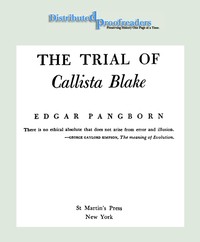
Pangborn frames the novel with two epigraphs: one from Montaigne on the authority of laws, another from paleontologist George Gaylord Simpson stating that 'no ethical absolute' arises without error. These are not decorative; they prime the reader to question legal certainty. The author's note insists the locale is 'semifictitious,' mapping New Essex onto any northeastern state within 300 miles of New York City—a deliberate vagueness that universalizes the setting. The acknowledgments cite Erle Stanley Gardner's The Court of Last Resort and Clarence Darrow's autobiography, linking the novel to real-world legal skepticism. Readers attentive to these paratexts will find a work less concerned with whodunit than with the flawed machinery of justice itself.
Because the excerpts are drawn from the trial's early stages, the outcome remains unknown. Readers should attend to Mann's evolving perspective and the small, telling details—a witness's shortness of breath, a defendant's unreadable calm—that accumulate beneath the legal surface. Pangborn's prose rewards patience; the novel's moral weight emerges not from plot twists but from the quiet friction between procedure and humanity.
Reader reflection
Record your reading impressions
A brief reflection can help important ideas stay with you longer.
Your progress
0
/
10
2
How did the book work for you overall?
3
Would you recommend this book to another reader?
4
How demanding did the text feel?
5
Would you like to discuss this book with someone?
6
Did the book deliver what you hoped for?
7
Would a second reading be valuable?
8
Did anything about the book feel genuinely new?
9
What did this book teach you most?
10